68%
We automate processes and give you back control of your business
We bring leads, orders, payments, and reports into one system: Automation OS. Data does not get lost, algorithms handle the routine, and you see real numbers on a dashboard.
The diagnostic session is free: 20-30 minutes.
- 30 days
- Foundation package: 1-2 key processes under control
- From 15 min to 30 s
- Order handling in our own store, Stylish Outfit
- 4-12 weeks
- From the first package to a full operating system
NEXORA / OPERATIONS
LIVE
SYSTEM
Process overview
4.2 min
-37%
System efficiency+42%
TEAM
Who runs the projects
 Artem KotsarFounder, automation
 Olha ChepenkoHead of Automation
 Kostiantyn DanylenkoDevelopment, WordPress
 Kateryna BondarievaWeb design
AUTOMATION
How AI works at Nexora
70%
24
~12 min
- AIFinds the project
- TogetherDiscussion and scope
- PeopleA person approves
- AIMonitors and reports
CONTROL
Control protocol
- Data does not move forward without validation: that is the Zero-Garbage standard
- AI watches the scenarios and reports failures on its own
/code5Emergency stop
If the AI could not fix a failure on its own after a few tries, one human command is enough to pause all of the company's automation until someone checks what happened.
- All automation paused
- Waiting for human confirmation
-18 h manual work / week
All systems operational
Where a business loses money and control
Many companies run into the same problems. The business runs on people's heroics rather than on a system.
| Problem | Now | After implementation |
|---|---|---|
| Leads get lost | Channels are scattered: Telegram, WhatsApp, calls, email, spreadsheets. You do not know how many customers your managers lost this week. | Every lead lands in the CRM or tracking system, duplicates drop, and each lead has a source and an owner. |
| A CRM nobody trusts | The system exists, but it is kept up somehow: data is inaccurate, analytics lie, and managers fill in fields when they feel like it. | Strict validation: a deal cannot move to the next stage until the key data is filled in. |
| Slow lead handling | No SLA, callbacks get forgotten, nobody checks. | SLAs and reminders, escalations, and overdue tracking. |
| Payments and invoices by hand | Invoices live in one place, payments in another, and statuses do not match. | Payment statuses are linked to deals, with overdue alerts and a payment register. |
| No clear reports | Reports are compiled by hand and the numbers disagree. | Daily and weekly reports arrive automatically: leads, conversion, revenue, overdue items. |
| Ads without control | Budget gets spent, but CPL and lead quality stay invisible. | An ads summary with spend, leads, CPL, and alerts on deviations. |
Automation OS: the operating system for your business
Your CRM, messengers, website, and accounting work as one network with shared statuses, rules, and ownership for the whole team.
Sales module
All leads from every channel (Instagram, Telegram, your website) in one window. Automatic assignment and SLA tracking.
Service module
Contracts and invoices generated in one click. Customers get notified about their order status.
Control module
Owner dashboards that show the pulse of the business in real time, so decisions rest on accurate data.
Our standard: Zero-Garbage
We build systems on the Zero-Garbage protocol: clean, accurate data that does not depend on the human factor.
Strict validation
The system will not let a deal move to the next stage until all key data is filled in.
One source of truth
You see real numbers on the dashboard (LTV, conversion, ROI) instead of the sales head's gut feeling.
Projects in numbers
Real projects: metrics, scenario diagrams, and results. Swipe to view each one.
Founder's own project
Stylish Outfit
Online store, dropshipping
Running since 2023, no issues
Orders per day
40-50
flow through the system
Order handling
30 s
was 15 min, 97% faster
Waybill (TTN) creation
1.5-2 s
was about 5 min
Daily work time on orders
23 min
was 11 h (calculated for 45 orders)
Managers per 100 orders a day
1
was 2-3
Build time
2 mo
from scratch: a month of design and a month of setup
System design: 1 monthSetup: 1 monthIn operation from 2023 to today
Work time is calculated for 45 orders (the middle of the 40-50 range) multiplied by handling time. Data comes from the founder's own project.
- WooCommerce
- Make
- Google Sheets
- Telegram Bot
- Nova Poshta API
- Checkbox
Client under NDA
Shopify: abandoned carts
Automatic reminders to shoppers, Keap CRM
Scenario targets
Delay before the reminder
15 min
automatic, no manager involved
Recovery Rate
up to 12%
abandoned carts that turn into payments
Open Rate
45-60%
emails sent at the moment of interest
CTR
15%
clicks on the restore-cart link
Marketer time saved
5-7 h
per week
Integration
Shopify + Keap
directly through the API
-
1
Shopify request
The scenario polls Shopify with an HTTP request and pulls Checkouts data in real time.
-
2
Data parsing
Raw JSON is split into fields: name, email, cart contents, total.
-
3
Each cart on its own
An Iterator handles carts one by one, so heavy data flow does not cause errors.
-
4
Keap database check
The contact exists: we update its history and add a tag. A new customer gets a new card.
-
5
Segmentation and reminder
Tags such as Cart > $100 or Product: Shoes. An email or SMS about the forgotten item goes out automatically after 15 minutes.
These are scenario targets, not a guarantee of results. We do not publish the client's actual data.
- Shopify
- Keap CRM
- Make
- Email / SMS
Client project
Shopify: order sync
Customers and purchases pass to Keap CRM automatically
Scenario overview
Scenario trigger
Scheduled
or manually when needed
Order data
6 fields
customer, email, phone, products, totals, statuses
Processing
Every item
checked and handled separately
Keap contact
3 actions
search, update, or create a new one
Segmentation
Auto-tags
by product, order type, scenario
Branching logic
Router
branches for different customers and contacts, scales without rewrites
-
1
Getting orders
On a schedule or manually, the scenario pulls new orders from Shopify: customer, email, phone, products, totals, statuses.
-
2
Data preparation
Data is aggregated and checked for structure and integrity.
-
3
Each order and item on its own
Variables are prepared for logic, tags, and conditions, so the scenario adapts to different data and product types.
-
4
Branching (Router)
Separate branches for different customer categories and for new and existing contacts.
-
5
Contact in Keap
First we look for the contact. If it exists, we update its data. If not, we create a new one.
-
6
Auto-tags
Depending on the product, order type, and scenario, the right tags are applied. That prepares customers for mailings and sales funnels.
What it gives the business
- No manual entry: fewer errors and time saved
- Shopify data reaches the CRM right away
- Contacts are always up to date
- Customers are grouped automatically
- The CRM is ready for analytics and marketing campaigns
This describes the scenario logic. We do not quote metrics for this project and do not publish the client's name.
- Shopify
- Keap CRM
- Make
Client project
Instagram Direct: lead automation
An Instagram message instantly becomes a structured request
Scenario overview
Source
Instagram Business
via a connected Facebook Page
Trigger
New only
old events are not reprocessed
Request data
7 fields
date, name, username, text, category, status, comment
Categorization
AI, optional
automatic classification of the message
Notification
Telegram
the manager sees the request right away
Auto-reply
Email, optional
confirmation to the client without the manager
-
1
New Instagram message
Instagram for Business captures a new Direct message.
-
2
Duplicate check
A filter rejects already-handled events, so one message cannot create several requests.
-
3
Request in Google Sheets
A row is created with the full request card: date, customer, text, status.
-
4
Manager notification
Telegram sends the key details right away, with no need to open Instagram.
-
5
AI classification
If enabled, OpenAI reads the text and assigns a category.
-
6
Auto-confirmation
If the business needs it, the client gets a confirmation email right away.
What it gives the business
- The message becomes a record instead of staying only in Direct
- The manager gets a signal in their usual work channel
- Statuses and a manager's comment appear on the request
- History can move into a CRM without losing structure
- The architecture is ready for a CRM, task manager, and SLA control
This describes the scenario logic. There are no confirmed numbers yet for response speed or conversion on this project, so we do not quote any. We do not publish the client's name.
- Instagram for Business
- Make
- Google Sheets
- Telegram
- OpenAI
Client project
Automatic website lead processing
A request instantly becomes a CRM contact and triggers the right action
Scenario overview
Intake
Webhook
any form or landing page
Backup
Google Sheets
for diagnostics and recovery
CRM contact
Airtable
matched by email/phone, then updated or created
Routing
Router
a different action per request type
Client confirmation
Gmail
an email right after the form is submitted
Consultation
Google Calendar
an event is created automatically when needed
-
1
Request intake
A webhook receives the new website request with all form fields.
-
2
Backup record
Google Sheets keeps a copy of the incoming data for diagnosing the scenario.
-
3
Airtable contact
The scenario looks up an existing contact by email or phone. If found, it updates the record; if not, it creates one.
-
4
Team notification
Slack or Telegram instantly notify the owner with a link to the CRM.
-
5
Routing by type
A router determines the request type (consultation, order, other) and triggers the right branch.
-
6
Confirmation and event
Gmail sends the client a confirmation, and for consultations Google Calendar creates an event.
What it gives the business
- A request instantly becomes a CRM contact or updates an existing one
- The team is notified without manually copying data
- Different request types trigger different next actions
- The client automatically gets a confirmation
- A calendar event is created on its own for consultations
This describes the scenario logic. There are no confirmed numbers yet for time saved or conversion gains on this project, so we do not quote any. We do not publish the client's name.
- Webhook
- Make
- Google Sheets
- Airtable
- Slack
- Gmail
- Google Calendar
Most of our other projects are covered by non-disclosure agreements (NDA), so we do not publish their names.
Case study, Stylish Outfit: from a click on the site to a waybill in seconds
This is our own project: we automated our online store first and then began building such systems for others. We can back up every number. Visit the store
Before
The store ran on dropshipping and every order was handled by hand: check it, copy the data, message the supplier, create the waybill and the fiscal receipt. One order took about 15 minutes, human error hit 5-10% of orders, and 100 orders a day needed 2-3 managers.
How long it took
We designed and built the system from scratch: about a month went into design and another into setup. It has run since 2023 and now handles 40-50 orders a day.
What was built
-
1
Webhook
The website (WooCommerce) passes the order to the system instantly.
-
2
Smart parsing
Product attributes are parsed: color, size, SKU. Validation blocks transfer errors.
-
3
Routing
The algorithm finds the right supplier in a Google Sheets database.
-
4
Telegram bot
The supplier is notified instantly. Their reply, in stock or out of stock, updates the order status.
-
5
Logistics
A Nova Poshta waybill (TTN) is created through the API and the PDF waybill goes to the supplier for printing.
-
6
Finance
Once shipping is confirmed, a fiscal receipt is issued through Checkbox and the customer gets an SMS with the waybill number.
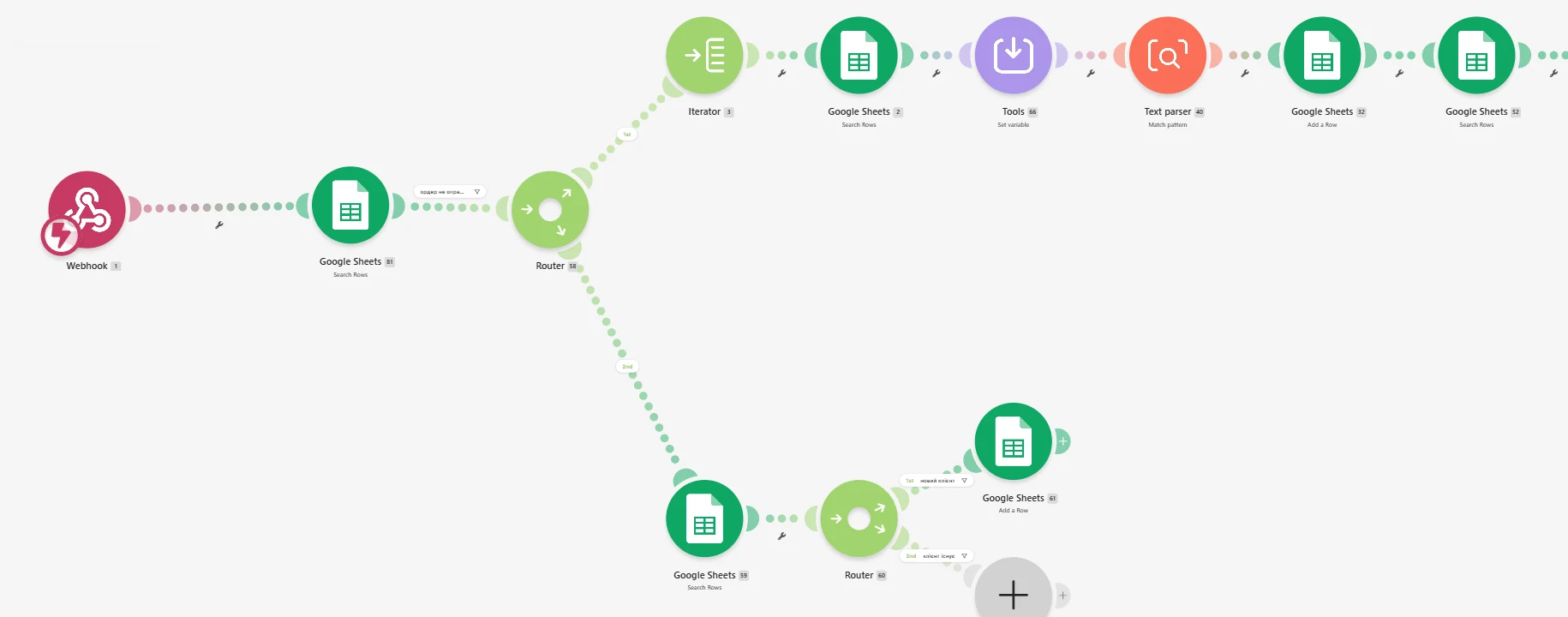

- The Webhook receives a new order from WooCommerce and Google Sheets checks that it has not been processed yet.
- A Router splits the flow. The lower branch looks the customer up: a new customer is added as a row, an existing one goes on without a duplicate.
- The upper branch: an Iterator walks through the order items, Google Sheets, Tools, and Text parser match them against the database and record the order.
- Next, a Router by payment method: for card payments, after a pause, HTTP requests run, Text parser reads the replies, and the result goes to Google Sheets. The other branch sends the order to the right supplier through the Telegram Bot.

- The Telegram Bot receives the supplier's reply.
- A Router identifies which supplier sent it. Text parser extracts the answer and Tools stores it in a variable.
- The next Router separates “out of stock” from “in stock”: Google Sheets finds the order and updates its row.
- For items in stock, a Router picks the branch by payment method (card or cash on delivery) and sends a Telegram message.
«We built the Stylish Outfit system from scratch in about two months. I spent roughly a month designing the scheme, and another month went into setup. Everything went smoothly and to plan. The system still runs today, and we have had no problems with it at all.»
What Stylish Outfit customers write
Four messages from real customers, confirmed by chat screenshots. This is not a curated sample, just the first ones confirmed in writing so far.
Good evening, the vest fits perfectly 🤍 My husband loved it, thank you so much 🤍
Yep, all good, thanks 😊
Everything fits, thank you for such a wonderful tracksuit 😉🙂
Good day, thanks, got my order, everything fits 🤗
What exactly we automate
We connect data sources (CRM, sales, finance, warehouse, support, marketing), set up processes in Make, and build clear analytics for the owner and the team.
Sales and CRM
- Leads from your site, forms, messengers, and ads collected into one stream
- Automatic lead assignment by rules, tasks, and deadline control
- Deals, contacts, and companies synced between your CRM and other systems
- SLA control: first response speed, overdue items, reasons for losses
Marketing and lead generation
- Data pulled from ad accounts and platforms
- Automatic campaign reports and alerts when metrics drop
- Leads linked to their source, with CPL, CAC, and ROAS calculated
Operations and tasks
- Unified statuses for projects and tasks, reminders, and escalations
- Checklists and procedures with completion tracking
- A summary for the manager and alerts in Telegram, Slack, or email
Finance and accounting
- Payments and expenses collected, plan vs actual, limit control
- P&L and cash flow that update automatically
- Data prepared for your accountant: registers, acts, summary tables
Warehouse, logistics, e-commerce
- Orders, payments, delivery statuses, and returns synced
- Stock and prices updated automatically, shortages flagged
- Waybills (TTN) created and customers notified
Support and service
- One inbox: tickets, classification, routing
- SLA control and escalation when a deadline is missed
- Knowledge base, reply templates, and reports on why customers contact you
Dashboards and analytics
- Owner panel: sales, profit, margin, expenses, forecast
- Funnel and conversion: stages, loss reasons, handling speed
- Operational metrics: SLA, response speed, deadlines, overdue items
- Finance: P&L, cash flow, receivables, plan vs actual
- Product analytics: ABC/XYZ, stock, turnover
- Marketing: ROAS, CAC, LTV, channel payback
- Regular reports in Telegram, email, or Slack
What we work with
- CRM
- SalesDrive, KeyCRM, MoyDrop, RemOnline, LP-CRM, NetHunt, Pipedrive, HubSpot, Zoho CRM
- Tasks
- Jira, Trello, Asana, ClickUp, Notion
- Communication
- Telegram, WhatsApp, Viber, Instagram, Facebook Messenger, X (Twitter), Threads, Email, Slack
- Sites and forms
- WordPress, Webflow, Tilda, Typeform, Google Forms
- Advertising
- Google Ads, Meta Ads, TikTok Ads
- Payments and logistics
- Stripe, PayPal, Wise, Monobank, PrivatBank, Checkbox, Nova Poshta
- Data and BI
- Google Sheets, Airtable, BigQuery, PostgreSQL, Looker Studio, Metabase, Power BI
The list is indicative: we connect by task and budget, depending on access and the service's API.
Who it is for
- Service businesses and agencies
- E-commerce and brands
- Manufacturing and logistics
- B2B companies with a long sales cycle
- Chains and projects where seeing the numbers and managing processes matters
What you get
- A process map and a list of priority automations
- Working Make scenarios with error handling and logging
- KPI dashboards with a clear structure and refreshed data
- Documentation: an integration diagram, procedures, and a user guide
- Support after launch: stability monitoring and improvements based on real use
Development: websites, apps, and custom solutions
Nexora does not stop at scenarios and integrations. We have developers on the team, so we can build a website, a custom app, or a module for your task. If a task falls outside our skills, we will say so honestly during the diagnostic.
Websites and e-commerce
- Corporate sites and landing pages, fast and SEO-optimized
- Online stores on WordPress and WooCommerce with custom code
- Multilingual builds and an HTML5, CSS3, SASS, and JavaScript front end
Custom apps and modules
- Plugins and modules for your business logic
- Internal tools: reporting, tracking, bonus calculation (for example, a promo-code reporting plugin for partners and managers)
- Scripts and two-way data exchange with Google Sheets (Google Apps Script)
- An app for a specific task: we agree requirements and scope during the diagnostic
Integrations and APIs
- Payment gateways: Stripe, Monopay, LiqPay, WayForPay, Portmone, NovaPay
- Logistics: Nova Poshta, Ukrposhta, Meest, Sendcloud
- CRM and fiscalization: KeyCRM, SalesDrive, MoyDrop, Checkbox
- Telegram API: notifications, mailings, chatbots
Design and UX
- Interface mockups in Figma
- UI/UX audit of an existing site
Data and marketing tech
- Google Analytics and Search Console
- Server-side UTM tracking
- Dynamic XML/JSON product feeds for ads without plugins
Cloud, email, migrations
- Google Cloud Platform
- Hosting and domain administration
- Migration from legacy CMS platforms (Simpla and others)
- Business email: SMTP, SPF, DKIM, DMARC
We set development price and timing after a brief and the diagnostic. It is a separate direction and is not part of the automation packages.
How we work: results in 30 days
You pay for results, not programmer hours. Work runs in 30-day sprints.
-
Week 1
Diagnostics
A 60-90 minute interview, collection of facts and access. A map of the current process and a list of problems and loss points.
-
Week 2
Design
A target scheme for 1-2 processes: steps, roles, statuses, triggers, rules. We agree the list of automations.
-
Week 3
Tracking base
We set up a CRM or spreadsheet as the tracking base: stages, fields, customer card, access rights.
-
Week 4
Launch
We build and test 1-2 automations, put them into operation, and accept the result against a checklist. Team training and documentation are part of the OS Start and OS Scale packages.
No surprises
- Scope is fixed in a scenario register: goal, inputs, outputs, services, and a definition of done
- The hour limit is included in the package, and anything beyond it only by agreement
- Scope changes go through a Change Request that estimates the effect on time and budget
- Acceptance follows a checklist; in OS Start and OS Scale the documentation and instructions stay with you
Acceptance criteria (Foundation package)
- The target scheme (to-be) is agreed for 1-2 processes
- The tracking base is set up: stages, fields, customer card, ownership rules
- 1-2 automations are built and tested
- A final mini report or dashboard is ready: what was done and what improved
Who works on your project
A team of specialists with clear roles works on your project.
System Architect
Designs the business logic and maximizes its profitability.
Integrator (No-Code)
Builds fast scenarios and integrations with Make and Zapier.
Developer (Code)
Writes custom modules for fiscalization, Monobank and PrivatBank statement sync, and complex API integrations.
The Nexora team: who is who
Real people stand behind every project. Open a card to read more about each of them.

Artem Kotsar
Founder of Nexora, IT integrator, and business systems architect
An entrepreneur with hands-on e-commerce experience. I break a business down into processes and build one system from CRM, Make, APIs, Telegram, and Google Workspace that runs without the owner's constant supervision.
LinkedIn profileStylish Outfit store4 years
in IT and automation
since 2023
our own online store, Stylish Outfit
40-50
orders a day handled by the system
- Make.com
- CRM
- APIs and webhooks
- Telegram
- Google Workspace
- System architecture
More detailsShow less
Who I am
An entrepreneur, IT integrator, and business systems architect. I specialize in process automation, CRM, integrations, centralized management systems, and analytics. I analyze a company's processes, find manual operations and loss points, design the solution architecture, and unite CRM, Make, Google Workspace, Telegram, APIs, and other services into one system. I build Nexora around the Automation OS concept: a complete system for sales, operations, finance, communications, and reporting.
What I can do
- Make and integrations
- Make.com as the central orchestration layer: event, conditions, actions, data routing, statuses, errors, notifications. APIs, webhooks, REST, JSON: where the system gets data, where it sends it, in what format, and what happens next.
- CRM
- Funnels, stages, fields, lead sources, statuses, loss reasons, roles and permissions, mandatory data entry, handing a client over between people and departments, reporting.
- Telegram
- Bots and Telegram as the internal interface of a business: notifications, requests, statuses, leads, system messages.
- Google Workspace
- Sheets, Drive, Docs, Gmail, and Calendar as building blocks of an automated system rather than just office tools.
- Data and calculations
- One source of truth, owner dashboards, internal calculators and calculation systems: projects, costs, payouts.
- Whole systems
- I design how data moves through the whole business: a new lead lands in the CRM, a manager is assigned, a task is created, after the sale the client goes to delivery, the payment is recorded, the data flows into financial records, and the manager sees everything on a dashboard.
- Business analysis
- I find out from the owner where people lose time, what is done by hand, where errors appear, where leads come from, how ad performance is measured, and where profit leaks. I turn 'our payments are a mess' into a system task: payment source, project, record, status, calculation, report, notification, exception control.
- E-commerce from the inside
- Since 2023 I have run my own store, Stylish Outfit: orders, suppliers, CRM, stock, margin, website, Telegram, SEO, customer communication. That is why I judge automation by sales, margin, and real operations.
How I work
I start with the business problem and only then pick the technical solution. The question is not which bot to build but which system will fully solve the client's problem. That is how the Automation OS concept came about. In my work I stick to a simple loop: measure, find the cause, change a parameter, check the result.
You will enjoy working with me if
You value clarity and honesty and are not afraid of hard problems. I do not promise it will be easy. I promise honest work and a real result.
Strengths
- I see structure where others see chaos
- I trust my team and stay out of other people's expertise
- I keep my focus on results rather than process
- I stay honest even when it is uncomfortable
- I can admit mistakes and change
Weaknesses
- I sometimes take on more than I need to
- I can be too direct
- I am demanding of myself, sometimes to the point of burnout
- I do not always stop in time
It is not a fit if
You need a contractor who quietly does the task. I work as a partner, not as a function.

Olha Chepenko
Head of the Automation Department
Builds efficient solutions that connect CRM systems, online stores, messengers, and AI services. Helps businesses cut manual work and run their processes more efficiently.
3+ years
of experience automating business processes
10 services
combined into a single solution
- Make
- Zapier
- API integrations
More detailsShow less
Strengths
- Communicates clearly with clients and the team
- Gets up to speed on a new service or API quickly
- Takes an integration all the way to stable operation, not just a first successful run
Tech stack
- Automation
- Make, Zapier
- Data
- Airtable, Google Sheets
- AI
- OpenAI
- Communication
- Telegram Bot API
- E-commerce
- WooCommerce, Shopify
- Integrations
- HTTP/API, Webhooks
Kostiantyn Danylenko
Senior Fullstack WordPress Developer and Technical PM
I build architecturally clean, fast, and secure e-commerce projects on WordPress and WooCommerce with custom code and no heavy page builders.
4+ years
as a Technical PM
10 years
in sales, in the role of Sales Director
- WordPress
- WooCommerce
- API integrations
More detailsShow less
Approach
I follow the Maximum Clean Code / Minimum Plugins principle: custom code instead of heavy builders and extra plugins. I design a site with conversion and business metrics in mind.
Business edge
Over 4 years as a Technical PM and 10 years in sales as a Sales Director. I manage project teams (developers, designers, marketers) effectively and make complex engineering decisions on my own.
Tech stack
- Backend and CMS
- PHP and WordPress (custom themes and plugins), WooCommerce, MySQL, REST API, Webhooks
- Frontend and UI
- HTML5, CSS3, SASS/SCSS, JavaScript (ES6+), WordPress AJAX, ScrollMagic, Swiper, Figma, React (basic experience)
- Logic and security
- Advanced Custom Fields, Polylang (multilingual sites), SEO in code (sitemaps, structured data, tags), data validation and security
- Cloud and email
- Google Cloud Platform, hosting and domain administration, migration from legacy CMS platforms (Simpla and others), business email (SMTP, SPF, DKIM, DMARC), Telegram API
Integrations
- Payments
- Stripe, Monopay, installments (Mono, Privat), LiqPay, WayForPay, Portmone, NovaPay
- Logistics
- Nova Poshta, Ukrposhta, Meest, Sendcloud
- CRM and automation
- KeyCRM, SalesDrive, MoyDrop, Make scenarios
- Fiscalization
- Checkbox: receipts are issued and recorded automatically on every transaction
- Data and marketing
- Google Analytics, Search Console, Google Apps Script for Google Sheets exchange, server-side UTM tracking, XML/JSON product feeds, a custom promo-code reporting plugin
Projects from Kostiantyn's portfolio
- KATI Shoes: a women's footwear store with payment systems, logistics, and SEO
- KamenYan: a multilingual corporate site with ScrollMagic animations
- Kaze: a women's clothing store with stock sync to KeyCRM, payments, and logistics
- Beaverix: an SEO-optimized landing page for a home renovation and maintenance service in Calgary

Kateryna Bondarieva
Web designer
A certified web designer. Helps brands stand out through aesthetically appealing and functional website and landing page design.
Design: stylishoutfit.com.ua4+ years
in web design, since 2022
- Web design
- Landing pages
More detailsShow less
Specialization
A web designer for websites and landing pages, including in the info-business niche. She combines an aesthetically appealing look with functional, easy-to-use design. At Nexora, she designed the team's own store, Stylish Outfit.
Partners
Companies we work with regularly and exchange clients with.

Full-cycle digital marketing agency
By its own description, Elit-Web ranks sites higher on Google through SEO, builds brand presence through SMM on Instagram, Facebook, and LinkedIn, and uses PPC for fast, measurable results when traffic is needed right away. We exchange clients: they send us requests for automation and CRM, and we recommend their services when a client needs traffic and ads.
elit-web.uaMore about the partnerShow less
12+ years
in the market, since 2014
2500+
completed projects
81 reviews
rated 5.0 on Clutch
They position themselves as a full-cycle agency that makes data-driven decisions. The key facts in brief:
- Services
-
- SEO
- PPC advertising
- SMM: Instagram, Facebook, LinkedIn
- Content marketing
- Partner status
-
- Google Premier Partner
- Meta Business Partner
- Agency clients
-
- IKEA
- Toyota
- Mercedes
- John Deere
- REHAU
- Results, by their own account
-
- 4M+ leads for clients
- Average ROI of 300%
- How we work together
-
- Elit-Web sends us automation and CRM requests
- We recommend Elit-Web when a client needs traffic and ads
Per elit-web.com and Clutch, as of September 2026. The illustrations are also from the partner's own site; they are examples of their materials, not our results.

Packages and pricing
The package is chosen by the scale of the task and how mature your processes are. We fix the exact price and module set after the diagnostic.
Foundation
Fixed price
€1,200
30 days
Small business: 1-2 key pain points and a need for a quick result.
- Diagnostics: a 60-90 minute interview and a process map
- A target scheme for 1-2 processes
- A CRM or spreadsheet as the tracking base
- 1-2 automations
- A mini report or dashboard: leads, conversion, sources
Everything included (6)Show less
- Diagnostics: a 60-90 minute interview, a current-process map (as-is), a list of problems and loss points
- A target scheme (to-be) for 1-2 processes: steps, roles, statuses, triggers, rules
- A CRM or spreadsheet as the tracking base: stages, fields, client card, basic access rights
- 1-2 automation scenarios, tested before launch
- A mini report or dashboard: leads, conversion by stage, sources
- 2 rounds of revisions on the agreed processes
50% prepayment, 50% after implementation and acceptance. Work starts within 3 business days of prepayment and access.
DiscussOS Start
Estimated price
€12,000
6-8 weeks
Mid-size business: disorder in 2-4 areas and a need for a system across several processes.
- Up to 10 automation scenarios, 6 modules
- CRM and sales, lead sources, notifications and follow-up
- Payments, email sequences, daily reports
- 120-140 hours of work
- Training for key users, documentation
Everything included (12)Show less
Everything in Foundation, plus:
- Diagnostics of several key processes with their owners, manual steps and loss points
- Data architecture: where information lives, which systems are the source, and how they exchange data
- CRM, Airtable or Google Sheets setup with roles and rules
- Up to 10 scenarios: triggers, conditions, routing, tasks, notifications, sync
- Integrations via ready connectors, webhooks or API
- An operational dashboard on agreed KPIs
- Testing of the main scenarios and typical errors before launch
- Training for key users: statuses, exceptions, dashboard, working rules
- Documentation: system diagram, instructions, scenario list
- Launch, monitoring of the first cycles, and stabilization
- A working communication channel for the whole project
- A final meeting and a plan for the next stage
40% at start, 40% once the CRM and main lead flows are ready, 20% after final acceptance.
DiscussOS Scale
Estimated price
€23,000
10-12 weeks
Many channels, ads, payments, and reports: a 360° system is needed.
- Up to 20 automation scenarios, 8 modules
- Lead assignment, SLA, loss reasons, quality control
- Payments and finance, advertising and analytics
- Daily and weekly KPI dashboards, operations and tickets
- Monitoring, an error log, and fallback routes
- Role-based training and a knowledge base
- 230-260 hours of work
Everything included (15)Show less
Everything in OS Start, plus:
- Deep diagnostics across departments: interviews with process owners, duplication and manual hand-offs
- A target architecture of links between departments, systems and roles
- Single sources of truth, required fields, and one KPI definition for every department
- A role-based access model and clear hand-off of tasks between teams
- Up to 20 scenarios, including cross-system and cross-department ones
- Integrations of several services: connectors, webhooks, API
- Consolidated dashboards: separate views for leadership and operations, drilling down to a deal or payment
- Monitoring of key scenarios, an incident log, and a response procedure
- Fallback routes for critical processes if automation is temporarily down
- Functional tests, checks of roles, data routes and critical chains, user acceptance
- Role-based training: leaders, managers, operational users
- Separate training for leaders on management analytics
- Documentation: architecture, integration map, knowledge base, process rules
- A phased go-live without stopping current work, then stabilization
- A development backlog: new processes, analytics, AI, integrations
40% at start, 40% once the CRM and main lead flows are ready, 20% after final acceptance.
DiscussWhat we need from you
- A contact person and 2-3 hours a week for approvals
- Access to the tools we need (CRM, email, forms, messengers) with admin rights during setup
- A short brief: what you sell, how requests arrive, who answers, which statuses you need
Not included in the packages
- Complex custom software, enterprise-grade ERP (that is the separate Development direction, estimated on its own)
- Deep website changes that require development (estimated separately)
- Third-party services and licenses: Make, CRM, mailing tools, telephony (paid on your side)
- Manual migration of more than 500 contacts or deals without an agreed import
- Unlimited revisions: the Foundation package includes 2 rounds of corrections
The subscription keeps your automations running every day: if something breaks or access, forms, fields, and rules change, we fix failures quickly and make small improvements. You pay for stability, response speed, and clear control in the system rather than for hours.
| Parameter | Lite€290 / mo | Standard€490 / mo | Pro€890 / mo |
|---|---|---|---|
| Hours per month | 4 | 6 | 10 |
| Channel | Telegram or email | Telegram or email | Telegram or email |
| Response time (business days) | Up to 24 hours | Up to 24 hours | Up to 6 hours |
| Critical failures | Priority | Priority | Priority plus proactive monitoring |
| Improvements | Fixes only | Fixes and small improvements | Fixes, improvements, planning |
| Monthly call | None | As needed | Once a month, 30 minutes |
| Proactive checks | None | Partial | Yes, key scenarios |
| Team training | None | Partial: 30-45 minutes | Full: 1-2 sessions, role-based videos |
| Mini report | Monthly | Monthly, with recommendations | Monthly, with a work plan |
Business days: Monday to Friday. A critical failure means a process has stopped: no requests or deals are created, notifications are not sent, or data does not reach your records. Extra hours beyond the limit: €80/hour or an hour bundle by agreement. Third-party services (Make, CRM, telephony) are not included.
Referral program for clients
Recommend us to another company and, once it pays, you receive a bonus as support credits (not cash).
| Client paid for Foundation | €290 credit or 1 month of Lite free |
|---|---|
| Client paid for OS Start | 1 month of Standard free or a credit of 5% of the project value toward support |
| Client paid for OS Scale | 2 months of Standard free or a credit of 5% of the project value toward support |
- The bonus is granted after the referred client pays the project in full
- Credits cannot be exchanged for cash, last 6 months, and can be used for a subscription or extra support hours
- No more than 2 free subscription months per referred client
- If the client was already in talks or in our CRM, the bonus may not apply (anti-duplicate rule)
Partner program for agencies and consultants
You recommend us to your clients and we share a commission: 10% of a Foundation project and 15% of OS Start and OS Scale. For example, a €1,200 project earns €120.
Payment follows 100% payment from the client, with the method and timing agreed individually.
Who it suits
- Accounting and audit firms
- CRM integrators and web studios
- Marketing agencies
- Business consultants
- IT companies
How it works
- You send us the client's contact via Telegram or email
- We contact the client within 1-2 days and run a free diagnostic
- We prepare a proposal and contract, and you can join the negotiations
- We deliver the project under the contract
- After payment, we send you your commission
Doubts we hear most often
Pick yours and we will answer the way we do on a first call.

Nexoraonline
You are young. Can you really pull this off?
Yes, the team is young, and we do not hide it. We first built our system on our own store, Stylish Outfit: since 2023 it has handled 40-50 orders a day. Deadlines in the contract are fixed and payment is split into stages, so the risk of a delay sits with us, not with you.
Want us to look at your own case in a free diagnostic?Free diagnostic
You will not understand how our business works
We build nothing until we understand it. The first stage is a 60-90 minute interview and a map of your process as it really is, exceptions included. The automation is fitted to your process, not your process to a template.
Want us to look at your own case in a free diagnostic?Free diagnostic
Our setup is too complex, this cannot be automated
At Stylish Outfit the chain is: order, supplier lookup, confirmation in Telegram, Nova Poshta waybill, fiscal receipt, SMS to the customer. All of it runs without manual work. If something truly is not worth automating, we will say so honestly at the free diagnostic session.
Want us to look at your own case in a free diagnostic?Free diagnostic
This is expensive
You can start with Foundation, covering 1-2 processes for €1,200. You pay the second 50% only after implementation and acceptance. For comparison, in our case study handling one order went from 15 minutes to 30 seconds.
Want us to look at your own case in a free diagnostic?Free diagnostic
We are too small, this is for big companies
Foundation is built exactly for a small business with 1-2 key pain points. You can start with one process and grow the system when the business is ready for it.
Want us to look at your own case in a free diagnostic?Free diagnostic
We have no time for this
We do the bulk of the work. From you we need a contact person, access to your services, and 2-3 hours a week for approvals.
Want us to look at your own case in a free diagnostic?Free diagnostic
My team will not use it
We build around how your team works today instead of forcing new habits. Key fields are required, so a deal cannot move forward on guesswork. OS Start and OS Scale include training for key users.
Want us to look at your own case in a free diagnostic?Free diagnostic
What if you miss the deadline or it does not work?
The deadlines in the offer are firm, not estimates. If we seriously miss them through our own fault, you can terminate the agreement and get back any prepayment above the cost of the work already done.
Want us to look at your own case in a free diagnostic?Free diagnostic
We will end up dependent on you
Services such as Make and your CRM are registered to you and paid by you. Rights to the scenarios built for you pass to you once fully paid. You keep all the access.
Want us to look at your own case in a free diagnostic?Free diagnostic
What happens after launch if something breaks?
After launch you can add a support subscription: Lite, Standard, or Pro. Response time on business days: up to 24 hours for Lite and Standard, up to 6 hours for Pro.
Want us to look at your own case in a free diagnostic?Free diagnostic
In development
How Nexora works inside: people and AI
We are building an automation system for Nexora itself. The team is minimal: a developer and an automator each own their own area and receive tasks from the AI. The AI takes only the work it can do 100% without errors. Decisions and accountability stay with people.
-
AI
Finds the project
Looks for potential clients and qualifies them, filtering out companies our services do not fit.
-
Together
Discussion and scope
The team talks to the client. The AI records requirements, requests the materials we need, and drafts the scenario register and the proposal.
-
People
Approval
We approve the scope and the proposal. Approval is one button in a private Telegram bot.
-
Together
Automation
The AI drafts scenarios in Make, and the developer and automator connect access, configure, and finish them.
-
AI
Contracts and monitoring
Contracts, invoices, and acts are created automatically. The AI watches scenario logs, tests them, reports failures, and formalizes scope changes as a Change Request.
Frequently asked questions
What is business process automation?
It means setting up scenarios that handle routine tasks without a person: assigning leads, changing CRM statuses, sending notifications, and syncing data between services. We use Make and integrations with your systems.
How long does implementation take?
Foundation takes 30 days, OS Start 6-8 weeks, and OS Scale 10-12 weeks. The project starts within 3 business days of prepayment and access.
What does the OS Start package include?
Up to 10 automation scenarios, 6 modules (CRM and sales, lead sources, notifications and follow-up, payments, email, reports), 120-140 hours of work, documentation, and training. The estimated price is €12,000, and we fix the exact quote after the diagnostic.
Do we have to connect everything at once?
No. We choose modules and integrations individually: on the first call we agree which processes to automate, which systems you already use, and what exactly goes into your setup.
Does the price include Make, CRM, and other services?
No. Subscriptions and licenses for third-party services (Make, CRM, mailing tools, telephony) are paid separately on your side.
What happens if the scope changes?
Scope is fixed in a scenario register. Changes go through a Change Request, where we estimate the effect on time and budget. Hours beyond the package limit only by agreement.
Do you build websites and custom apps?
Yes. We have developers who build websites and online stores on WordPress and WooCommerce, custom modules, and integrations with payment systems, logistics, and CRMs. We set price and timing after a brief, separately from the automation packages.
Is there support after launch?
Yes. Support subscriptions: Lite (€290/mo), Standard (€490/mo), Pro (€890/mo). You pay for stability, response speed, and clear control in the system rather than for hours.
Do you train our team?
Yes, in the OS Start and OS Scale packages, in using the system: how to work with statuses and where to see requests, payments, and notifications. Fixing scenarios and configuring APIs and integrations is our responsibility, so we do not train your team on that.
Can I see real examples?
Yes. The Stylish Outfit case above comes with numbers and screenshots of the scenarios. Most of our other projects are covered by non-disclosure agreements (NDA), so we do not publish their names.
From the blog
Breakdowns of processes, integrations, and what is actually worth automating first. Written by Artem, Nexora's founder.


Interactive matching
What format does your business need?
Answer four short questions. The system will give you a preliminary format, timeline, and focus for the first stage.
- No lengthy questionnaire
- An instant result
- About 2 minutes
The diagnostic session is free: 20-30 minutes.
Question 1 of 425%
Preliminary recommendation ready
The optimal starting point
OS Start
Timeline
Scenarios
Focus
The first stage could include
The final scope and price are set after a short walkthrough of your processes.